
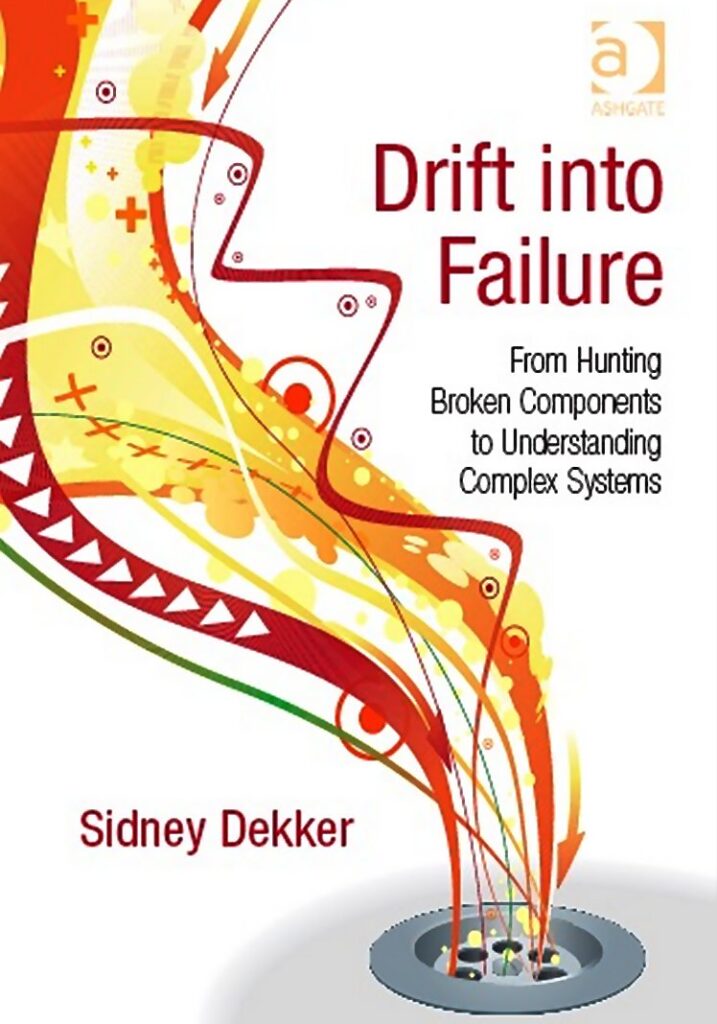
These were systems that drifted into failure. While pursuing success in a dynamic, complex environment with limited resources and multiple goal conflicts, a succession of small, everyday decisions eventually produced breakdowns on a massive scale. We have trouble grasping the complexity and normality that gives rise to such large events. We hunt for broken parts, fixable properties, people we can hold accountable. Our analyses of complex system breakdowns remain depressingly linear, depressingly componential – imprisoned in the space of ideas once defined by Newton and Descartes. The growth of complexity in society has outpaced our understanding of how complex systems work and fail. Our technologies have gotten ahead of our theories. We are able to build things – deep-sea oil rigs, jackscrews, collateralized debt obligations – whose properties we understand in isolation. But in competitive, regulated societies, their connections proliferate, their interactions and interdependencies multiply, their complexities mushroom.
This book explores complexity theory and systems thinking to understand better how complex systems drift into failure. It studies sensitive dependence on initial conditions, unruly technology, tipping points, diversity – and finds that failure emerges opportunistically, non-randomly, from the very webs of relationships that breed success and that are supposed to protect organizations from disaster. It develops a vocabulary that allows us to harness complexity and find new ways of managing drift.
★★★★★
U.S. Chemical Safety Board
Professor Dekker explodes the myth that complex economic, technological and environmental failures can be investigated by approaches fossilized in linear, Newtonian-Cartesian logic.
